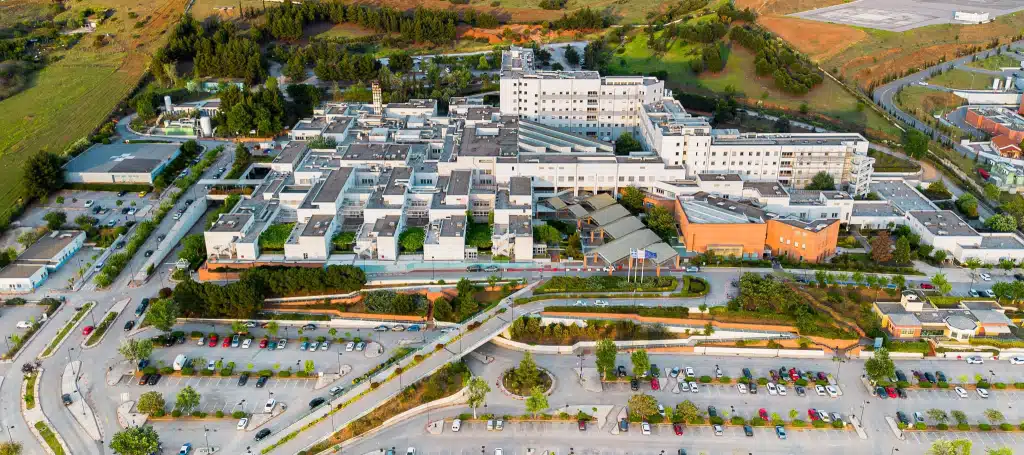
Papageorgiou Hospital: Revolutionizing emergency care with Claris FileMaker
Discover how Papageorgiou Hospital transformed its emergency room with a custom Claris FileMaker solution, eliminating paper records, streamlining patient care, and unlocking real-time data insight.
Cathy
21 April 2026
•
 6
6
min
Industry
Healthcare
Challenge
Streamline and modernize the emergency room workflow at Papageorgiou Hospital, eliminating paper-based bottlenecks.
Solution
Real-time emergency room management platform to manage the entire patient journey efficiently.
Benefits
- Faster, more efficient patient management
- Improved coordination across departments
- Enhanced visibility and decision-making
- Better patient experience and satisfaction
At Papageorgiou Hospital in Thessaloniki, the emergency room operates on a 24-hour rotating duty schedule, handling between 6,000 and 7,000 cases every month.
In an environment like this, every second counts.
The challenge: Breaking the “paper barrier” to patient care
Like many large medical institutions, the hospital faced a familiar yet critical problem: its emergency room was drowning in paperwork.
Every patient arrival triggered a physical form that followed them through their entire journey. Doctors wrote notes by hand. Nurses tracked medications manually. Laboratory results were processed separately. Over time, decades of patient documentation accumulated in storage rooms: data preserved, but never truly accessible.
With approximately 800 patients per day, the manual system created bottlenecks at every stage.
The hospital needed more than digitization. It needed clarity, speed, and coordination.
The solution: A digital lifeline for the ER
The new system needed to do more than just digitize records, it had to prioritize patients by urgency, track their journey in real time, and give doctors instant access to critical information. It also had to be intuitive enough for non-technical staff.
Having worked with Claris FileMaker in the past, the hospital’s IT manager knew the platform’s potential but needed a partner to turn his vision into reality. In 2023, he turned to Pineapple, a Greek Claris Partner known for innovative, tailored solutions.
His question was simple but ambitious: Could FileMaker integrate with SAP and replace the hospital’s outdated paper system?
From the outset, the collaboration was built on speed and shared ownership. The hospital’s IT department worked shoulder-to-shoulder with Pineapple, taking an active role in quality assurance and user acceptance testing rather than simply reviewing deliverables from a distance.
Using an agile framework, the two teams moved in tight weekly cycles during the early iterations, identifying issues, validating fixes, and deploying updates in days rather than months. This hands-on partnership was a decisive factor in compressing what could have been a lengthy development timeline into a single, focused month.
Within one calendar month, Pineapple delivered a custom FileMaker platform that integrated directly with SAP. The solution was designed to address every pain point in the ER’s workflow, addressing the ER’s key workflow pain points from intake to discharge.
Instant patient registration & smart triage
The journey begins at reception. When a patient is registered in SAP, the record is instantly pushed to FileMaker via API. There is no delay, no duplication, and no manual transfer.
This real-time synchronization ensures that the ER team is ready to evaluate the case immediately, assigning urgency levels and appropriate departments without a second of delay.
Orchestrating the entire patient journey
Emergency care rarely ends in one department. Patients frequently move between departments for consultations, tests, or specialized care.
The FileMaker system tracks every step of their journey.
- Seamless referrals: If the ER ward needs a specialist’s opinion, the system ensures the specialist has full context and, once the opinion is rendered, the record flows back to the primary ER ward automatically.
- Live lab integration: Laboratory results (blood tests, biochemical analyses, urine tests, and more) automatically populate via API, giving medical staff a real-time view of the patient status.
- The “fail-safe” queue: In a high-stakes hospital environment, “System Busy” is not an acceptable answer. Pineapple engineered a sophisticated queuing system that retries data updates every minute if a record is temporarily locked, ensuring no lab result or vital sign is ever dropped.
 In a hospital, you don’t have the flexibility to miss something. Our system works like clockwork to ensure every lab result and every note is captured.
Stathis Askaridis, founder and CEO of Pineapple.
A single, intuitive interface
Understanding that ER doctors cannot waste time navigating complex menus, Pineapple designed one unified view: symptoms, vital signs, clinical notes, and results visible at a glance.
Dynamic web viewers display checkboxes and wrap-around text, ensuring doctors see the right information at precisely the right moment.
Smart templates that save critical time
To ease the transition from pen to keyboard, the system includes configurable template libraries for common emergency scenarios.
Doctors can select pre-built documentation and adjust it as needed, significantly reducing typing time.
“All those options for symptoms—they’re all managed and configurable per department,” Stathis explains. “Nothing is hard-coded. Everything is clean and adaptable to each department’s needs.”
The impact: efficiency that saves lives
After two years of operation, the results are tangible.
The transition to our new FileMaker based platform in the Emergency Room was about more than just eliminating paper; it was about reclaiming the health-care provider’s valuable time. By replacing manual, fragmented processes with a seamless, automated workflow, we have fundamentally shifted our focus back to where it belongs: providing urgent, high quality care to our patients. We are no longer managing files. We are managing health.
Labros Dermentzoglou, Head of IT
Turning clinical feedback into rapid innovation
The move from paper to digital was a significant cultural shift. While the transition from decades of handwritten notes, it quickly became clear that the medical staff were setting high expectations to ensure the new solution would empower them to work even better.
Pineapple’s agile approach made the difference: when users identified specific clinical requirements or workflow optimizations, updates were delivered within days, sometimes overnight. By listening and responding rapidly, questions quickly turned into lasting confidence.
Empowering medical teams across the hospital
The system supports 14 active users (IT manager, doctors, nurses, and reception staff). But its reach extends far beyond the emergency room: hundreds of hospital staff can access read-only information across the hospital network, leveraging FileMaker Data API.
Doctors in other departments can access a web-based view showing what happened during a patient’s emergency room visit: medications administered, tests ordered, symptoms recorded.
This seamless information flow eliminates redundant questions, reduces medical errors, and ensures continuity of care.
Turning data into operational intelligence
The transformation did not stop at digitization. With structured data now available, the hospital gained something it never had before: measurable performance insights.
Administrators can now:
- View real-time pivot tables showing cases by department and month
- Analyze average elapsed time per clinic
- Identify bottlenecks through AI-generated reports that visualize case volumes against processing times
- Track hourly patient flow patterns to optimize staffing
This shift from reactive to proactive management hasn’t just improved workflows, it has redefined how the hospital delivers care, ensuring that resources are always aligned with patient needs.
Reducing patient anxiety through transparency
The benefits extend beyond staff efficiency to the patient experience itself. Four to five large TV screens now display department-by-department status updates throughout the waiting areas.
The impact was immediate: complaints about waiting times dropped sharply. Patients now understand their position in the queue and the stage of their care, transforming the ER experience from anxious uncertainty to informed confidence.
Reliability at scale
Perhaps most impressive is the system’s reliability: zero bugs after a first couple of iterations, despite the complexity and volume.
It manages the entire hospital emergency operation. There are no performance issues, even with all this data in one list view.
Looking ahead: Continuous innovation for better care
AI-powered voice documentation
Building on FileMaker’s AI capabilities, Pineapple is now developing a breakthrough enhancement that will address data entry itself.
The new system will allow doctors, who often wear gloves and work in chaotic, noisy emergency environments, to simply press a button and speak into a microphone, without interrupting medical focus.
Using Whisper AI, the process will:
- Decode Greek audio even in high-noise environments
- Convert speech to text with medical accuracy
- Intelligently search the template library and past records for matching scenarios
- Auto-populate documentation based on what it heard
The goal transcends efficiency, it’s about restoring human focus. Less time staring at screens means more time making eye contact with patients, observing subtle symptoms, and providing the compassionate care that defines emergency medicine.
The collaboration between Papageorgiou Hospital and Pineapple demonstrates that digital transformation in healthcare is more than replacing paper with screens, it is about reclaiming time for care.
By leveraging the agility of Claris FileMaker, the hospital has built a real-time operational backbone that connects people, departments, and data – and continues to evolve alongside the clinical teams that depend on it.
Feeling inspired?
Learn more about how Claris FileMaker can help you increase efficiency in your organization – get in touch.
Let’s talk